Build a Film Deck Without Borrowed Movie Stills
Build a Film Deck Without Borrowed Movie Stills
A film deck can make a project visible without finding a finished movie that looks like it. Start with the relationship an image needs to explain. Then choose something you can make: a drawing, an object photograph, a location study, a spatial diagram, or a page where the placement of a few words does the work.
The question is not “What goes where the movie still would have gone?” It is “What does this reader need to see?” That change matters. A placeholder invites you to imitate a surface; an explanatory task gives you a reason to make an image of your own.
This does not make borrowed references inherently unsuitable. An appropriate reference can communicate something precise. But a deck built without them needs its own visual vocabulary, not an apology for lacking the appearance of a completed film.
Begin with something that can be shown
“An intimate drama about family” offers little direction for an image. “A woman can hear her brother downstairs, but cannot confront him without admitting she was listening” identifies a relationship between people, rooms, and information. You can draw that relationship before you know the final location, casting, or lighting.
Consider Upstairs, an original fictional chamber film used throughout this example. Nessa is sorting her late mother's belongings in an apartment above the family repair shop. Below, her brother Felix agrees to sell a radio Nessa thought they were keeping. She hears the agreement through the stairwell; the apartment door opens onto it. To challenge him, she must come downstairs and reveal that she listened.
Two visual questions follow. How can she hear an exchange she cannot see? How will the film keep us with her rather than cut downstairs to explain it?
The questions are related, but they are not identical. A drawing that answers the first may disclose the whole building. A drawing that answers the second may need to hide most of it. That difference gives two pages distinct jobs before you choose a typeface or collect textures.
Write the question beside the proposed image. When the question remains abstract—“Does this feel emotionally powerful?”—try naming the action or relationship that would make the feeling particular. When no visual question emerges, a sentence may be enough. You do not have to illustrate every paragraph.
Choose the material for the information it supplies
For Upstairs, a rough section through the building can establish the apartment above the shop and the opening between them. It need not resemble a photographed frame. Its advantage is precisely that it removes details irrelevant to the spatial relation.
That advantage is also a limit. A schematic line cannot demonstrate how a voice would actually carry through a particular building. A dashed route labeled “proposed overheard voice” explains the story's intention; it is not an acoustic survey.
An original location-study photograph would supply different information. A picture taken from an upstairs doorway could reveal the depth of a landing, the width of the opening, or what the camera can see from that position. It would not establish that the location is available for production, that sound travels as the script requires, or that the finished film will have the light visible in the study.
An object photograph has another job. A radio with a repaired corner and handwritten station markings could make the contested possession more particular. But the image alone would not tell us who wants to sell it or why keeping it matters. Those are story relationships, not properties the photograph can verify.
A type-led page can carry a contrast without pretending to depict anything. Place “She hears the agreement” apart from “He has not told her,” and the page can direct attention to unequal knowledge. Keep the actual exchange in the text. Decorative typography cannot substitute for the missing situation.
None of these materials wins in the abstract. Choose the one that answers the page's question while making the fewest misleading implications. A plain drawing that explains the scene is more useful here than an elaborate room rendering that suggests decisions the filmmaker has not made.
Make a representative pair before building the whole deck
The two pages below use original schematic drawings. They are not photographs, location evidence, or a proposed final art direction. Their purpose is to test whether a small visual vocabulary can carry both story information and a filmmaking choice.
Page one: give the reader the spatial relationship
The story page's headline is:
She hears the sale before she sees her brother.
The drawing shows two stacked rooms. Nessa is upstairs beside boxes; Felix is downstairs in the repair shop. A stair opening connects them. A dotted line follows the proposed route of his voice toward her.
Beside it, the copy reads:
Nessa sorts her late mother's belongings upstairs. Below, Felix agrees to sell a radio she thought they were keeping.
To challenge him, she must descend and admit that she was listening.
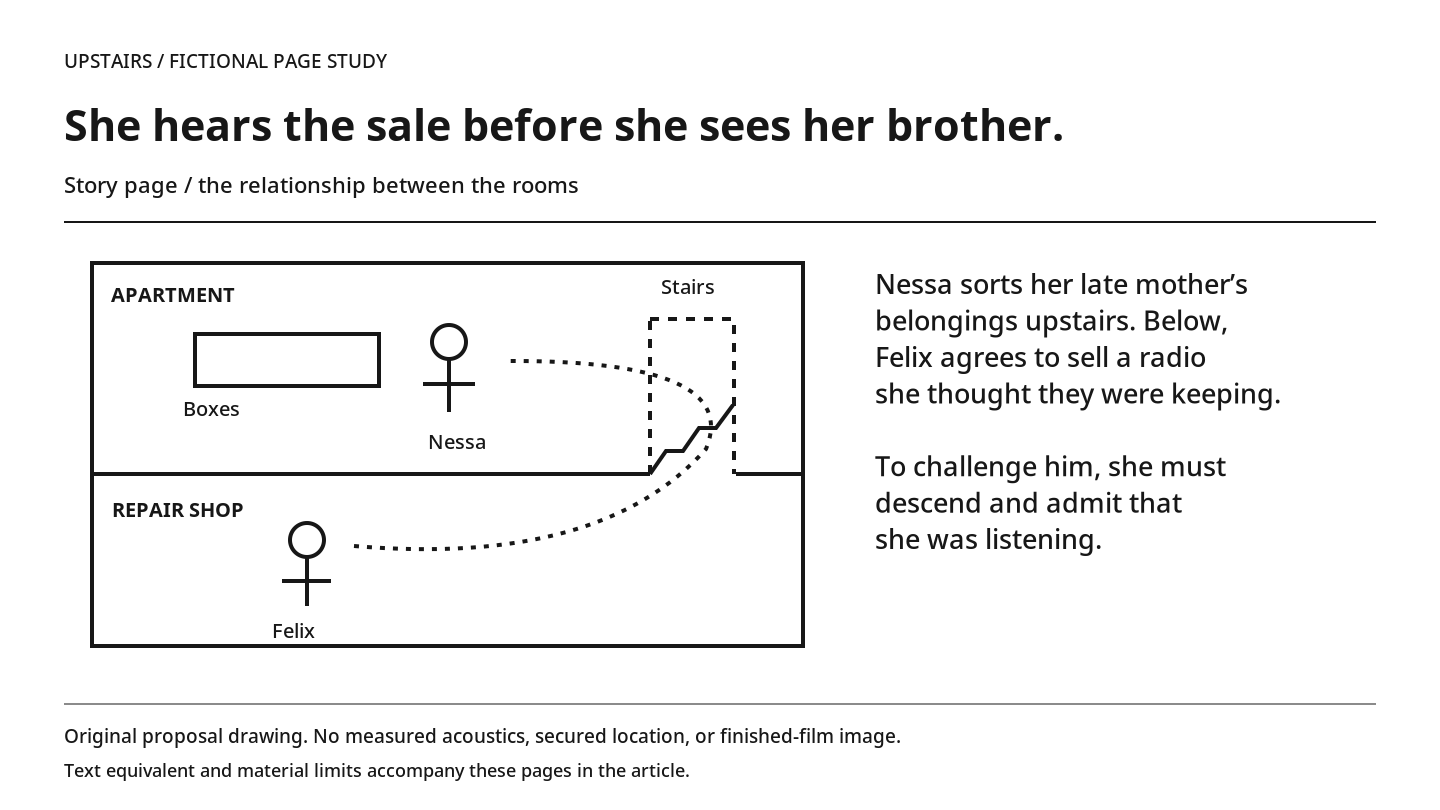
The page separates what the drawing establishes from what the language supplies. The drawing locates the people. The sentences explain the disputed object and why the route downstairs is a decision rather than mere movement.
Remove the sentences and you still have two people on different floors, but not this scene. Remove the drawing and the scene remains understandable, but the reader must construct its spatial relation from words. Keeping both is justified because each contributes something the other does less directly.
The page labels the dotted route as proposed, and the surrounding explanation states its limits: the drawing is not an acoustic survey and not evidence that a location has been secured. That qualification is part of the explanation. Without it, a clean plan could look like the result of a location decision that has not happened.
Page two: show what the film withholds
The approach page uses a different headline:
The voice gets in. The camera stays with her.
Instead of repeating the building section, its rectangle contains only Nessa, the boxes, and the apartment door. Felix and the shop are outside it. Dotted marks at the doorway stand for the proposed voice.
The accompanying copy reads:
Stay upstairs with Nessa as the terms of the sale reach her through the door.
Felix remains offscreen. Do not cut downstairs to confirm the exchange.
Her descent becomes a decision, not an insert.
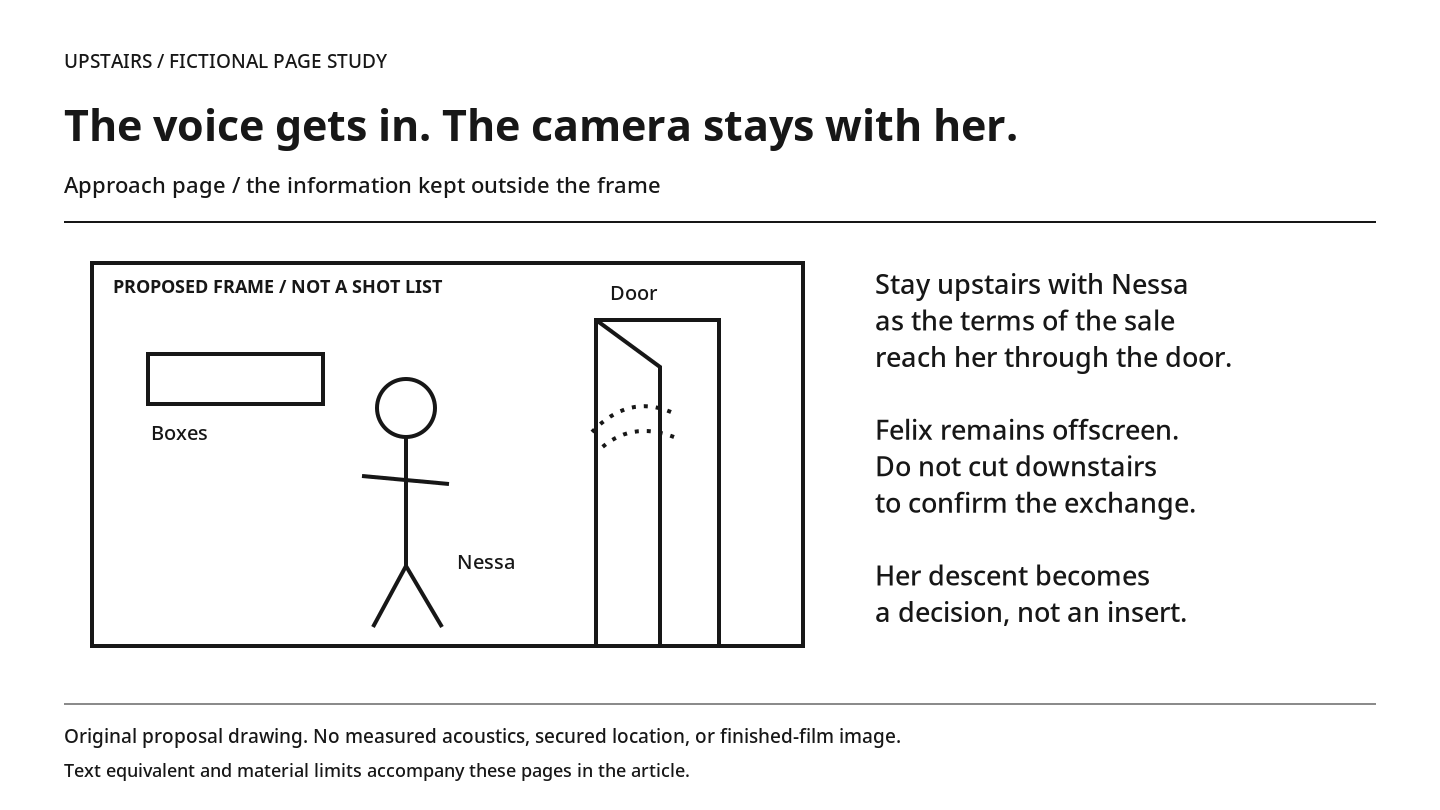
Now the reader can distinguish the deck's explanation from the film's presentation. The first page gives us an overview to understand the scene. It does not propose an establishing shot of both floors. The second page describes the restricted view the film would use.
That distinction is easy to lose when every deck image is treated as a promise of a future frame. Label the material's job. “Spatial relationship” and “proposed frame” tell the reader how to interpret two drawings that otherwise share the same graphic language.
Make consistency carry meaning
The pair repeats a restrained line treatment, a rectangular image area, plain labels, and captions in the same place. Those decisions allow the image's job to change without making the document feel like a new project on every page.
Sundance Collab's guidelines recommend visual consistency and legibility across pitch materials.[^1] Here, those broad principles become specific choices: room outlines remain solid; proposed sound remains dotted; explanatory labels sit outside the action they identify.
The consistency should help a reader interpret information, not merely recognize a style. If a dotted line marks sound on the first page and a camera route on the next, the matching marks conceal a changed meaning. Either keep the convention or explain the change.
Scale can vary for a reason. The story drawing includes both people because the relationship between them is the subject. The approach drawing makes Nessa larger and excludes Felix because the proposed restriction is the subject. Forcing identical compositions would make the pages more uniform and less useful.
The same applies to empty space. The approach page does not need a second image of the brother to balance the layout. That empty visual capacity belongs to the idea: the other person remains unavailable to our view. Adding an image merely to fill it would contradict the sentence beside it.
Coherence comes from keeping the explanations compatible. The visual surface supports that work; it cannot do it alone.
Know what the pair still cannot show
These drawings communicate geography and withheld information. They do not communicate photographic texture, subtle performance, the room's actual dimensions, or the quality of light on Nessa's face. Calling the pair “cinematic” would not supply those missing things.
Decide whether the recipient needs them for the next conversation. A collaborator discussing the scene's construction may have enough to identify the intended restriction. Someone being asked to respond to a particular photographic treatment may need an additional original test or study. The answer is a relevant new material, not a stronger adjective attached to the existing diagrams.
A location-study caption could say, after the photograph actually exists: “Comparable upstairs threshold, photographed for spatial research; not a proposed or secured filming location.” Add the photographer and date to the asset record. Explain which feature matters, such as the visible turn of the landing. Do not label an imaginary or generated room as a photographed location study.
The right material can also change as the project develops. A rough plan might establish an early question, then give way to a photograph that answers it. Keep the earlier drawing only if its explanatory role remains useful. Originality does not require preserving every asset you made.
Keep authorship and intended use attached to the asset
“Original” is a description of how material came into being, not a complete account of who may use it. For a US example, the Copyright Office says a photograph's author and initial owner is generally the photographer, subject to limited work-made-for-hire exceptions.[^2] Commissioning a photograph should therefore prompt a conversation about its agreed use, not an assumption that every right has transferred.
Keep a short record with each asset: who made it, what it depicts or proposes, why it is included, and what use has been agreed. A drawing created for this deck and a photograph supplied for private discussion may need different handling. The record should make that difference visible without pretending to be legal clearance.
Also separate authorship from what the image claims. Making your own drawing of a building does not secure the building. Photographing an object does not prove its story history. A caption should identify the relationship you can support, rather than borrow certainty from the image's finish.
Extend the explanation, not the image count
Before producing the rest of the deck, read the pair without its working notes. Can you identify what Nessa hears, what she must do to respond, and what the camera refuses to show? Those are questions for review, not claims that an audience has already understood the pages.
Then name the next unresolved visual question. For Upstairs, it might be how Nessa's use of the apartment changes after she goes downstairs. A third page showing the same floor plan with one new decorative texture would add little. A purposeful change in position, access, or framing could develop the film's visual argument.
The pair is ready for that review, not a substitute for it. Its useful achievement is modest and concrete: two different page jobs are carried by original material, and neither page pretends to be evidence of a finished film. That is a workable beginning for a deck without borrowed movie stills.
Sources
[^1]: Sundance Collab, Pitch Deck for Fiction and Nonfiction Feature Films, p. 1, “Design.” Inspected September 19, 2026. Supports the bounded recommendation on consistency and legibility; the fictional drawings and page-building method are original editorial examples, not a Sundance case study.
[^2]: US Copyright Office, What Photographers Should Know about Copyright, “A Note on Works Made for Hire.” Inspected September 19, 2026. Cited only for the general US starting point on photographic authorship and the existence of exceptions, not for clearance of any particular asset.
Frequently asked questions
What should replace a borrowed movie still in a film deck?
Start with the relationship an image needs to explain, then choose something you can make: a drawing, object photograph, location study, spatial diagram, or a page where the placement of a few words does the work. Ask what the reader needs to see, not what goes where the movie still would have gone. A placeholder invites you to imitate a surface; an explanatory task gives you a reason to make an image of your own. Borrowed references are not inherently unsuitable, but an appropriate reference should communicate something precise.
How should I choose among a schematic drawing, location study, object photograph, and type-led page?
Choose the material for the information it supplies while making the fewest misleading implications. A rough section through a building can establish that an apartment sits above a shop and that a stair opening connects them, but it cannot demonstrate how a voice would carry through a particular building or that a location is secured. An original location-study photograph could reveal the depth of a landing, the width of an opening, or what a camera can see from a position, but it would not establish availability, sound behavior, or final light. An object photograph can make a contested possession more particular, but not who wants to sell it or why keeping it matters. A type-led page can carry a contrast without pretending to depict anything, but decorative typography cannot substitute for the missing situation.
What do the two Upstairs pages show separately?
The story page uses the headline “She hears the sale before she sees her brother,” with a drawing of two stacked rooms: Nessa upstairs beside boxes, Felix downstairs in the repair shop, and a dotted line marking the proposed route of his voice. The copy explains the radio sale and why confronting him means admitting she was listening. The approach page uses the headline “The voice gets in. The camera stays with her,” with a frame containing only Nessa, the boxes, and the apartment doorway; Felix and the shop are outside it. The text says Felix remains offscreen, not to cut downstairs to confirm the exchange, and that her descent becomes a decision. The first page gives an overview to understand the scene; it does not propose an establishing shot of both floors. The second describes the restricted view the film would use.
What can these diagrams not show?
They communicate geography and withheld information, but not photographic texture, subtle performance, actual room dimensions, or the quality of light on Nessa’s face. Calling the pair “cinematic” would not supply those missing things. Decide whether the recipient needs them for the next conversation; someone discussing the scene’s construction may have enough, while someone responding to a photographic treatment may need an additional original test or study. A location-study caption could say, after the photograph actually exists, that it is a comparable upstairs threshold photographed for spatial research, not a proposed or secured filming location. Do not label an imaginary or generated room as a photographed location study.
What authorship and usage record should accompany each asset?
“Original” describes how material came into being, not a complete account of who may use it. For a US example, the Copyright Office says a photograph’s author and initial owner is generally the photographer, subject to limited work-made-for-hire exceptions. Commissioning a photograph should therefore prompt a conversation about its agreed use, not an assumption that every right has transferred. Keep a short record with each asset: who made it, what it depicts or proposes, why it is included, and what use has been agreed. Also separate authorship from what the image claims: making your own drawing of a building does not secure the building, and photographing an object does not prove its story history.